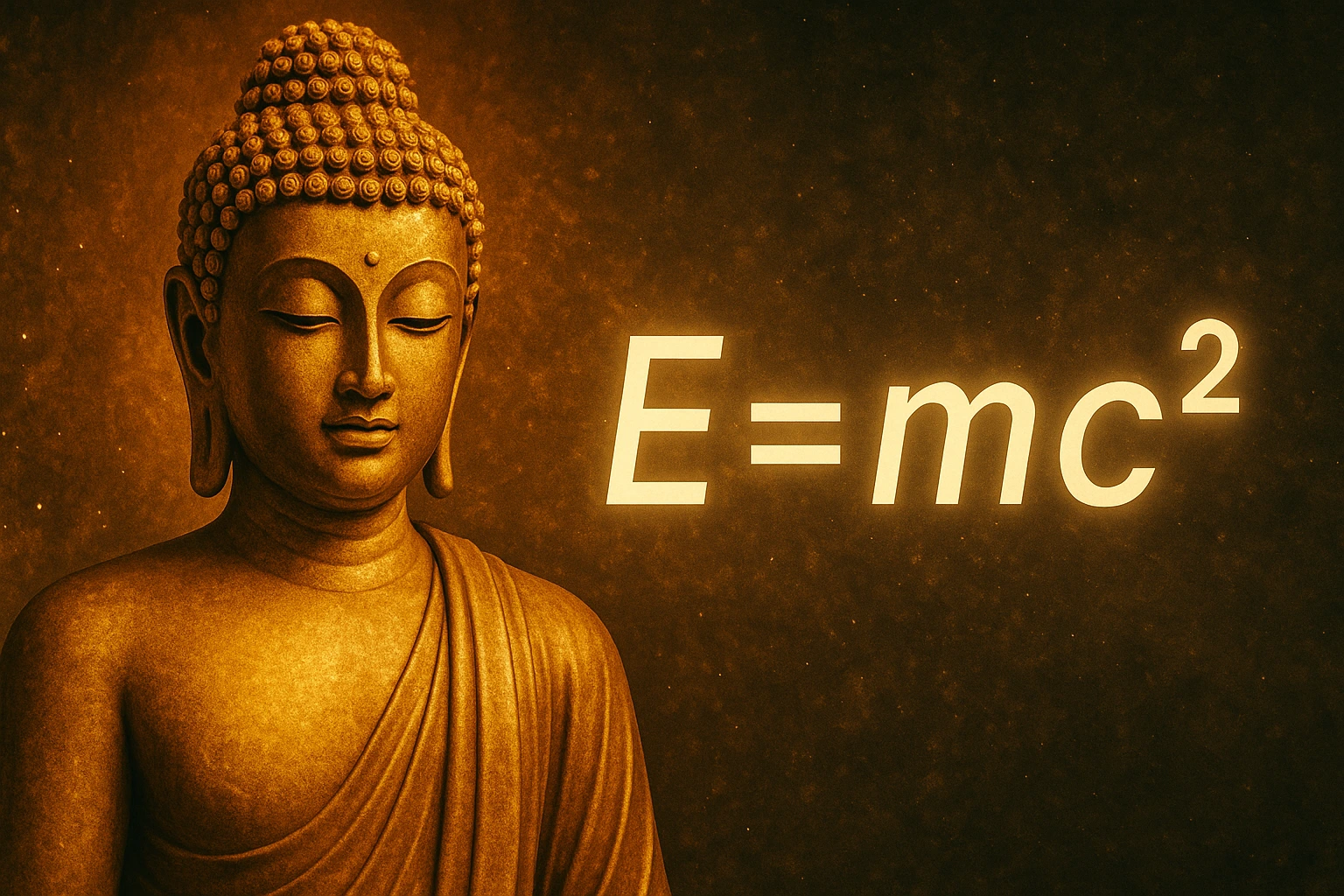
# The Flow of Life: Rebirth Meets Einstein's Equation
In a world increasingly shaped by science and reason, the timeless teachings of the Buddha continue to illuminate our lives in profound ways.
One of the most fascinating and often misunderstood aspects of Buddhist philosophy is rebirth — the continuation of life beyond death, not as a permanent self or soul, but as a flow of energy and intention.
Surprisingly, this ancient concept finds a poetic reflection in one of modern science’s most famous equations:
E = mc²
🔁 What is Rebirth in Buddhism?
In Buddhism, rebirth isn't the reincarnation of a fixed soul.The Buddha taught that there is no unchanging self (anatta), but rather a dynamic stream of consciousness influenced by karma — our actions, intentions, and mental habits.
When we die, this stream doesn't end; it finds new expression, much like a flame lighting another candle.
It's not the same flame, yet not entirely different.
This process is driven by cause and effect — just as a seed becomes a tree, our mental energies give rise to new forms of existence.
⚛️ Enter Einstein: E = mc²
Einstein’s equationE = mc² tells us that:
This law of physics resonates deeply with the Buddhist view of reality:
Nothing truly disappears — it only changes form.
When the body dies, the physical mass (m) might return to the earth. But the energy (E) — our thoughts, emotions, intentions, and karmic imprints — continues in a different form.
Just like mass becomes energy under the right conditions, our life force continues its journey, shaped by the momentum of karma.
🌊 Energy Never Dies — It Transforms
Buddhism teaches that life is a flow, not a fixed identity. Our thoughts and deeds don't vanish into nothingness — they ripple outward, shaping not just this life, but what comes next.Einstein showed us that energy is eternal. It doesn't fade away — it transforms. In the same way, our karmic energy carries forward into the next rebirth, not as a soul, but as a continuation of patterns.
Imagine a wave in the ocean: it rises, moves, and eventually fades — yet the energy that formed it continues, forming new waves.
This is rebirth in Buddhism: not the same, but not different.
A new form, carrying the essence of the past.
🔬 Science Meets Spirituality
While Buddhism doesn’t rely on physics to explain its truths, the harmony betweenE = mc² and the concept of rebirth is striking.
“Energy cannot be created or destroyed, it can only be changed from one form to another.”
— Albert Einstein
Buddha would agree — and perhaps add:
“Life is not owned. It flows. What we do with it echoes beyond form.”
🌱 Conclusion: Living with Mindful Energy
When we understand rebirth not as a mystical idea but as a continuation of energy, it changes how we live.Every action we take, every word we speak, every thought we entertain — they’re all seeds that shape the future.
Whether you believe in karma or equations, one truth stands out:
We are energy in motion. What we do matters.
So let’s live mindfully, compassionately, and with purpose — because the energy we release today becomes the wave of tomorrow.